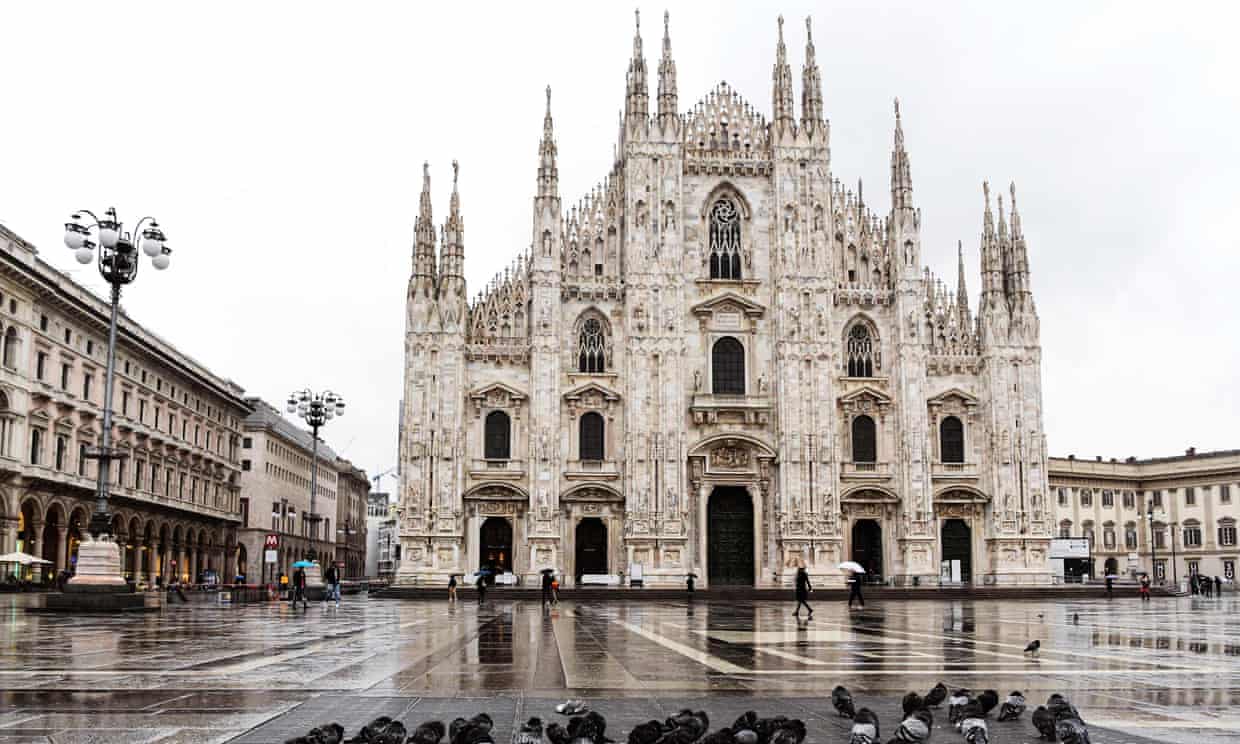
Featured Image: Milan’s Duomo Deserted, Via Getty Images
Part 1. Today we’re going to look at the dysfunctional Italian economy and political system and the impact of COVID-19.
Since 2008, a new normal has emerged across the globe. Low economic growth and high rates of inequality have led to a resurgence of populism from every conceivable corner of our society.
The crash in 2008 occurred as social media began to play more important roles in our lives, opening the door to a steady flow of disinformation. This toxic mixture has played a key role in notable global events – including Bolsonaro, Trump, Brexit, the AFD, AMLO and so on. Social media and disinformation will continue to shape our society for the worse in the years to come.
There has been much talk of a so-called “quarantine culture”, a phenomenon which has bought people together despite their social, economic and political divides. Our media platforms have perpetuated this narrative by broadcasting feel-good images of Italians playing the accordion, sharing wine and singing the national anthem from their balconies. Unfortunately, reality as always is more sinister.
A venomous cocktail of economic stagnation, populism, and disinformation has found fertile ground and has been flourishing in Italy for over a decade now. Despite the “blitz-esque” spirit being portrayed by the media, COVID-19 has and will only serve to worsen our [the Italian] political landscape.
A bit of context
Politics is the Italian nation’s favorite pastime and of course, no one has a better grasp of macro-economics, Sino culture or the intricate workings of the World Bank better than your average Italian. Anyone who has ever lived in Italy knows what I mean. It’s a tall order attempting to avoid a political discussion, anywhere you go – be it the barbers, the bar or the post office – you will find yourself entering into a political debate with varying opinions as to how to reform the state and who is to blame for the country’s ills. The usual culprits are; the political class, globalists, the EU [in particular, France and Germany], immigrants, the right-wing, the left-wing, and the Freemason, for good measure.
These culprits are often viewed as the powers that be and anti-establishment and anti central-authority feeling has been common-placed in Italy since the renaissance and even has its own name “campenalismo”, a literal translation would be “loyalty to one’s bell tower”.
This feeling has only been exacerbated by Italy’s inability to recover from the 2008 financial crisis. I think it’s a fair statement to say that Italy, and in particular Italian industry [Car production, Food, Pharmaceuticals, Maritime] has been hit hard by globalization, even if other sectors like tourism have prospered.
From this context, populist parties like The League party emerged which is currently led by arch Euro-sceptic, Matteo Salvini. Originally, The League was The Northern League, a secessionist/ federalist movement aiming to separate the economically prosperous North from Roman dominion – a gleaming example of Campenalismo. It has since mutated and adopted its populist position as being the only party truly standing for Italian national interests, a county which it had previously wanted to break up.
Salvini has since been joined on the populist right by the Fratelli D’Italia (Brothers of Italy) party led by Giorgia Meloni which emerged in 2012. Fratelli D’italia has its roots in the post-Second World War fascist movement and from its inception has taken on a tough anti-immigrant, anti-EU and pro-nationalist stance. Both parties often utilize twitter to great effect, and in a similar manner to Bolsonaro and Trump, have a penchant for spreading conspiracy theories. Even the 5 Star Movement which is currently in the coalition government can be classed as a populist movement, and yes, even they have flirted with theories of dubious nature, most notoriously against compulsory vaccinations (we had a measles outbreak in 2015, 4 people died).
Italy’s economy, the sick man of Europe

COVID-19 will irrefutably take a heavy toll on the Italian economy. Industrial output, tourism and services have ground to a halt and the subsequent recession looks like it will become a U-shaped recession and last for 3-4 years.
This will have disastrous effects on national debt, which in 2018 stood at over $2.9trn or 134.80% of GDP and a staggering $46,573 per capita. This is in stark comparison to France[1] whose debt stands around the 100% mark or Austria at 75% of GDP. In fact, only Greece has a higher national debt in Europe of 178.2% and the European average is 84.2%. Too make matters worse the Italian credit rating with S&P has been hovering around the BBB- with a negative outlook.
This hasn’t always been the case, just 30 years ago national debt stood at $838bn and accounted for around 88% of GDP, moreover, the S&P credit rating was a healthy AA+.
Pension spending amounts to 17% of GDP
It’s a common knowledge that Italy has the second oldest population in the world and currently 23.1% of Italians are over the age of 65. In addition, the life expectancy for an Italian currently stands at 83, whilst fertility rates remain amongst the lowest in the world at 1.32. The government was slow to act in raising the retirement age to 67, which just ten year prior was a generous 59 years old. This means that many who retired in the 2000s can expect to recieve a pensions well into 2030s. Daniele Franco argues that such measures have resulted in Italy having the highest pension proportionate expenditure in the develop world having risen from 5% in 1960 to 17% in 2016. Once again, the only European country which foots a larger pension bill is Greece.

The Italian civil legal system is amongst one of the most complicated in the world and often results in a lack of transparency. The economist Mushtaq Khan points out, transparency and excessive bureaucracy often results in an extractive form of corruption. This form of corruption being notoriously damaging to public trust in institutions and to the economy. Italy’s transparency index ranks at 51st globally behind the likes of Dominica and Georgia but slightly above Argentina and St Lucia.
Public administration ranks amongst the most inefficient in the OECD
Then there is state bureaucracy, which has become a bi-word for incompetence and inefficiency. Aberbach, in his 1981 piece “Bureaucrats and Politicians in Modern Democracies” identified the Italian civil servant as the “classical bureaucrat” . The Italian civil service has undergone numerous reincarnations in its history from the Piedmontese orientated administration of the Savoyards to the militaristic service under Mussolini. Its current form came about following the birth of the Republic where high unemployment resulted in the creation of paternalistic job appointments relating to political parties. Lewanksi and Toth say this process created an unprofessional and unproductive administration that has failed to modernize and has often placed conformity over innovation. This heavily centralized and hierarchial service offers little opportunity for horizontal and external mobility and remains a career choice for many that enter. As a result Italy remains a highly-developed economy but retains a pre-modern civil administration. This slow-moving antiquated management of basic governmental duties stifles and delays the private sector and remains a constant frustration for millions of Italians. This, however, did not stop a staggering 48% of GDP being spent on public administration.
The World Economic Forum in 2015 attributed a significant part of Italy’s decline and stagnation since the 1990s to the ineffectiveness of the civil administration.

Moreover, a regressive tax-system serves only to hinder job and economic stimulation with many Italians electing to move abroad to open businesses. Youth unemployment hit an astonishing 42.67% in 2014 and over 500,000 have emigrated since. This brain and labour drain will only additional pour fuel on the demographic bonfire.

The turbulent political landscape made up of fragmented coalitions has resulted in 61 different governments since the Second World War. Horsetrading is a necessity for the passing of bills and many attempts at reform, as seen last summer, often result in the collapse of governments. Other factors have prevented reform such as mass-strikes organised by trade unions but for the sake of this argument it is best to cover them in a separate article.
The New Order
This decline has taken place in tandem with global events that have opened the door to populists. Italy’s entrance to the Euro, immigration, the relocation of factories, the inability to compete with cheaper mass-manufactured products from abroad have prevented a useful deflection from reform.
I am not saying that Italy is solely to blame for her problems, nothing is that simple in this world, but the country’s malaise has been capitalised on by populists. As long as the problem is caused ‘by an other’ there is no real need to self-reflect or push through painful and unpopular reforms. The populists also offer a channel to vent anger for many who feel they have been left behind by the new economic reality.
As Italian companies relocate many view the past with nostalgia and the present with pessimism.
In the past, young graduates from the University of Turin knew that, if they so wished, a long-term career at FIAT laid ahead of them. In 1970, FIAT employed over 100,000 Torinesi and the Agnelli family were viewed the respect and reverence. FIAT was a lynchpin of the economy, mass-producing automobiles and appliances and its generous, paternal attitude towards its employees attracted thousands of workers from across the country. Many hark back to these times as a golden era when an honest living paid dividends. Over the last 4 decades much has changed and FIAT recently merged with Chrysler and in 2018 moved its headquarters to the Netherlands and its tax domicile to the UK. The few factories that remain in operation, primarily in Modena, are now being threatened with closure due to COVID-19. The numerous young graduates in Turin have since had to search for work in other places, often precarious and temporal. I have used FIAT as an example as it was the most quintessential of Italian companies during the economic boom, now like many others including, Barletta, Vodafone, 3, TIM and Pirelli have all started to outsource operations.
![[lingotto_fiat.jpg]](https://culligan.politics.blog/wp-content/uploads/2020/04/c0c71-lingotto_fiat.jpg)
The social consequences have been severe
Frustrations and anger over previously mentioned poor administration and the seeming indifference from large corporations to their social responsibilities has risen over the last 2 decades, as has poverty. Italy emerged from the 19th century as one of the poorest countries in Europe and entered the 21st as one of the richest in the world. Unfortunately, that social progress has also halted. According to ISTAT (Italian office for national statistics) around 5 million Italians (8.4%) were living in absolute poverty in 2018. The figure for relative poverty was even higher at 15% with unemployment at 10%. Its hardly surprising from these figures why pension reform, for example, is immensely unpopular or where populists like Salvini, Meloni and even the 5 Star Movement can draw their support from.
The central-government has failed to put the brakes on this Sisyphes-esque situation and the recent coronavirus outbreak and the subsequent economic impacts may push even more into the arms of Girogia Meloni and Matteo Salvini.
Isn’t this article supposed to be about COVID-19?
The Coronavirus outbreak has hit Italy harder than any other country in the world. As of today over 115,000 are infected with a death toll a sombre 13,915. Despite the sacrifices of everyday Italians in fighting the virus, which they should be applauded for, the consequences of the outbreak will linger for years.
The world is facing an economic crisis due to national lock-downs and a decline in the stock market. The emphasis now is on containing the recession and preventing it from turning into a global economic depression. Italy unfortunately, will have further economic misery heaped on it and will probably be the biggest sufferer in the EU. Most financial analysts point to a 2-3% contraction in the first quarter of next year.
The current strain on employers has resulted in the state stepping in to introduce a £24bn stimulus package and implementing similar economic measures as the UK, e.g. paying redundancy payments of up to 80%. The effect of these measures will do little to off-set the damage done to a modern economy which is based on inter-connectivity. Even in the near-impossible situation of the lock-down ending on the timetabled date of the 13th of April, the economic outlook would still remain bleak.
I previously mentioned in passing that the Italian tourism industry has benefited from globalization and currently accounts for 14.4% of national production. It is very much a key-stone of the Italian treasury and millions of Italians depend on it for daily sustenance. Here in Liguria, where I live, many hedge their bets on a successful tourist season, opening their restaurant or hotel for just 7 months of the year and employing many on seasonal contracts. I have also previously mentioned that many young Italians have entered precarious temporal work, about 1,540,000 Italians currently work in the tourism industry. It is almost a certainty that this pandemic will decimate their livelihoods and hit the entire area as a result, a term referred to as the “negative multiplier effect”.
Importantly, tourism is not the sector we should be worried out. Italian banks and the crippling amount of bad loans have often raised concerns that they are moments away from collapsing and in need of a bailout. As there is very little economic movement during a lock-down it becomes increasingly likely that both small and medium businesses will struggle to repay loans and pay staff, even with government assistance. This shortfall of profits will inevitably hit the banking system. With every day passing it becomes increasingly likely that the banks will need to be bailed out and that the predicted 2-3% contraction maybe wishful optimism.
The bailout, if required, would almost certainly come from European funds and would bring with it conditions. Italy is often viewed by its European counterparts as being irresponsible and reckless as seen from the 2019 budget dispute. Any terms offered in a bailout would be conditional on economically tightening its fiscal policy and making cuts to its state funding. This may be necessary in the long-term but in the meantime it’s going to be a siren song for the populists. Globalist bankers who have destroyed the country being aided by the EU who refused to help Italy in its moment of need and has got rich off Italian labor whilst we suffered. I can already picture the narrative.
The near future looks increasingly bleak for Italy. In Part 2 we’re going to look at how this economic downturn will affect Populism in Italy and how disinformation and conspiracy theories are spreading at a similar rate to the virus itself.
PART 2. We’re now going to assess the impact of COVID-19 on populism and dinsformation in Italy.
Part 2 is due for publication on the 5/5/20
 Politiking